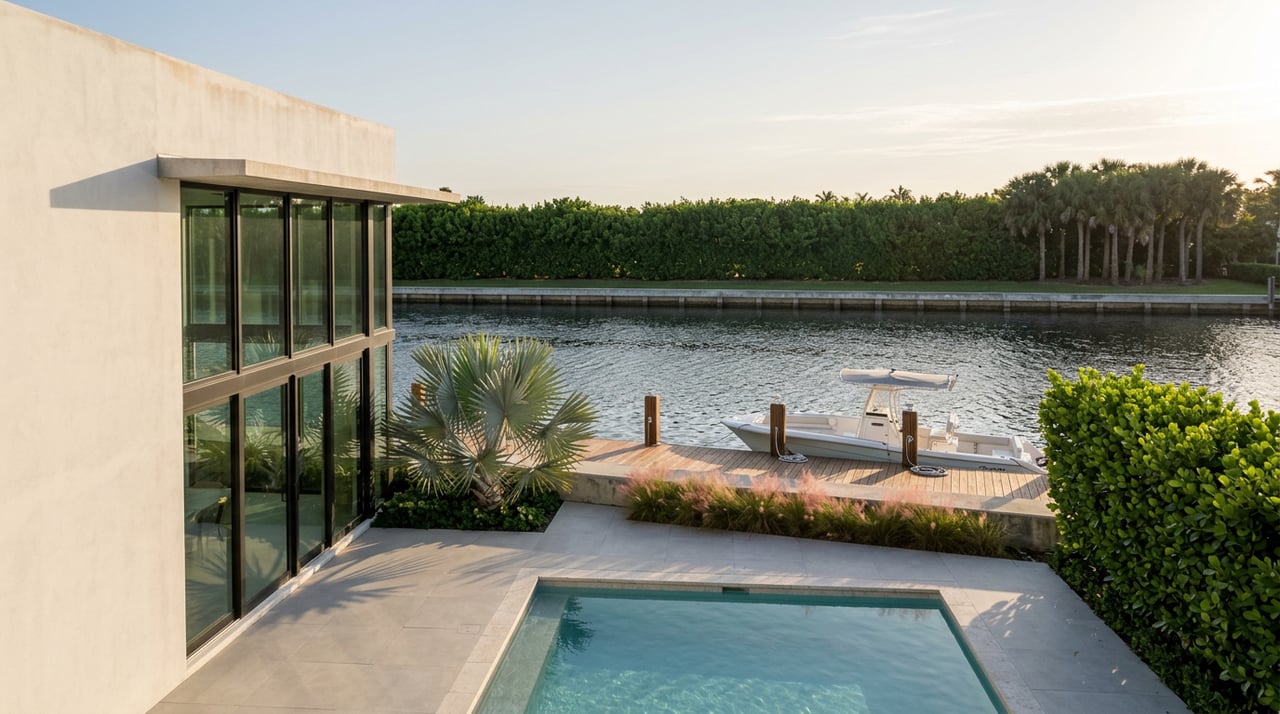
Agents who have sold homes on Kingfish Road learn a specific, counterintuitive lesson early: the most expensive water in Royal Harbor is not always the best water for the boat tied up at the dock.
The pie-shaped lots that fan out to open bay along Kingfish Road are the address every Royal Harbor buyer wants to see first. Wide frontage, unobstructed sunset views west across Naples Bay toward Port Royal, the kind of setting that tends to end negotiations rather than start them. But an open-bay dock sits exposed to wind fetch and passing boat wake in a way a protected interior canal simply does not. A vessel moored on Kingfish Road takes more chop, more fender wear, and more attention during an afternoon squall than the same boat tucked two streets back on a finger canal. It is a detail most buyers never think to ask about until after closing, when a passing sportfisher's wake is knocking their own boat against the dock on a calm Saturday.
That gap between what a Royal Harbor address signals and what it delivers for the person who actually owns a boat is the reason the neighborhood's median price is close to useless as a planning number. It tells you almost nothing about what you are buying, because in Royal Harbor the house has rarely been the point.
The Same Zip Code, Three Different Markets
Royal Harbor's roughly 400-plus single-family homes sit on the eastern shore of Naples Bay, laid out on a network of canals developed from the 1950s through the 1970s. Every one of those canals eventually connects to the bay and then to the Gulf through Gordon Pass, with no fixed bridges along the way. That single fact, no-bridge Gulf access, is what puts Royal Harbor in the same conversation as Port Royal and Aqualane Shores rather than communities north of downtown like the Moorings and Park Shore, where boats exit through the narrower, more tide-sensitive Doctors Pass.
But "no bridges" describes the exit, not the neighborhood. Inside Royal Harbor, listings active in mid-2026 ranged from interior canal homes priced near $2.8 million up to a bayfront estate on Snook Drive listed above $14.9 million, all within a footprint of roughly half a square mile. A market snapshot taken June 3, 2026 showed the median list price across about three dozen active Royal Harbor properties sitting near $3.95 million, with homes typically taking close to five months, about 146 days, to find a buyer. A separate broker analysis of trailing twelve-month closed sales, published in early June 2026, put the actual sold median closer to $2.5 million, up sharply from the year before.
Those two numbers are not describing a discrepancy. They are describing two different Royal Harbors. The sold-price median pulls in the condos at Oyster Bay and Four Winds, along with older, unrenovated homes still trading in the low seven figures. The active-listing median skews toward the wave of new construction and rebuilds that now regularly starts around $6.5 million. A buyer comparing "Royal Harbor's median" to a listing they are considering is often comparing a 1970s bungalow to a 2024 rebuild and calling it one market.
The Lot Is the Asset
The reason that split exists is a construction pattern that has reshaped the neighborhood for about fifteen years. Royal Harbor has gone through a sustained cycle of tear-downs and rebuilds, with older, smaller homes replaced by custom estates designed by architects like Stofft Cooney. The pattern is consistent enough that experienced buyers now treat most Royal Harbor purchases as a land-and-dock decision first and a house decision second. Frontage, canal width, turning room, and sun orientation carry more of the long-term value than square footage or finish level, because in a neighborhood where the existing structure is as likely to come down as stay up, the water is the part that does not get demolished.
That framing matters for how a buyer should actually shop the market. A dated four-bedroom on a wide, protected canal with good depth at the dock is not a compromise. It may be the better long-term asset than a newer home sitting on a narrow, shallow finger canal, because the canal is the constraint that no amount of renovation can fix.
Pat Wilkins closed a Royal Harbor transaction in February 2026 at $15.15 million, reported as the highest bayfront sale the neighborhood had seen in more than four years. That kind of number gets attention for the price alone, but the more useful lesson underneath it is the same one Kingfish Road teaches every serious boater: the water the house sits on determined the ceiling long before the architecture did.
What to Actually Check Before You Offer
Because Royal Harbor's value sits in the canal rather than the structure, the diligence that matters here is different from a typical Naples purchase. Before writing an offer, a buyer working with proper representation should confirm:
- Depth at mean low water, both at the dock and along the transit route to Naples Bay, with the date the reading was taken
- Boat lift capacity, reach, and service history if one is already installed
- Seawall condition and whether any repair permits are on file
- Overhead power lines near the dock, which can limit vertical clearance for masts or tall T-tops even where there are no fixed bridges
- Typical transit time to Gordon Pass at different tides, since currents run stronger near the pass during ebb and flood
- Whether recent dredging has addressed any local shoaling history
Gordon Pass itself is well marked and maintained as the primary entry point to the Gulf from Naples Bay, but boaters should still expect variable, single-digit controlling depths at chart datum in places, a detail confirmed in the federal Coast Pilot guidance for the region. That is not a reason to avoid the neighborhood. It is a reason to verify draft against depth before assuming every dock in Royal Harbor suits every boat.
One more structural detail catches buyers coming from gated communities off guard: the Royal Harbor Homeowners Association exists and keeps residents informed. That is part of why Royal Harbor has become a magnet for buyers priced out of Port Royal, where the same NABOR-sourced reporting placed the single-family median closer to $16 to 17 million in 2025. Royal Harbor offers the same bridge-free run to the Gulf at a fraction of the entry price.
Reading the Water Before the Listing
None of this means Royal Harbor is a puzzle only an insider can solve. It means the standard shorthand, comparing square footage and a median price across listings, does not work here the way it works in a subdivision with repeatable floor plans. Two homes three doors apart can represent genuinely different assets once you account for canal width, depth, sun exposure, and whether the dock sits in open bay or a protected slip.
For a buyer who has already toured a few Royal Harbor listings and started to sense that the numbers do not line up the way they should, that instinct is correct. The fix is not a better spreadsheet. It is spending time on the water itself, at the actual dock, at a realistic tide, before deciding what a given address is really worth.
Common Questions About Buying in Royal Harbor
Does every home in Royal Harbor have deep-water Gulf access? Nearly every property connects to Naples Bay and then Gordon Pass with no fixed bridges, but canal width and depth vary block to block. Wider canals near Kingfish Road and bay-front positions generally accommodate larger vessels, while interior canals suit mid-size powerboats and center consoles better.
How is Royal Harbor different from Port Royal if both have Gordon Pass access? Both share the same bridge-free route to the Gulf, but Port Royal's canals tend to run wider, and its 2025 single-family median sat far higher, in the $16 to 17 million range. Royal Harbor offers a version of the same boating access without the gated pedigree or the price tag.
Is a Royal Harbor home a renovation candidate or a teardown? It depends entirely on the lot. Given the neighborhood's active rebuild cycle, many buyers now evaluate the canal frontage and depth first and treat the existing structure as a secondary consideration, whether that means a light renovation or a full rebuild.
Understanding which canal actually supports your boat, and which lot is worth building on, takes more than a listing sheet. If you are comparing Royal Harbor to Port Royal, Aqualane Shores, or another Naples waterfront community and want a straight read on what a specific address can and cannot do for your boat, Pat Wilkins can walk the dock with you before you write an offer. Schedule a Consultation to talk through the water first.
This article is general information, not legal, tax or financial advice. Consult a qualified professional about your situation.