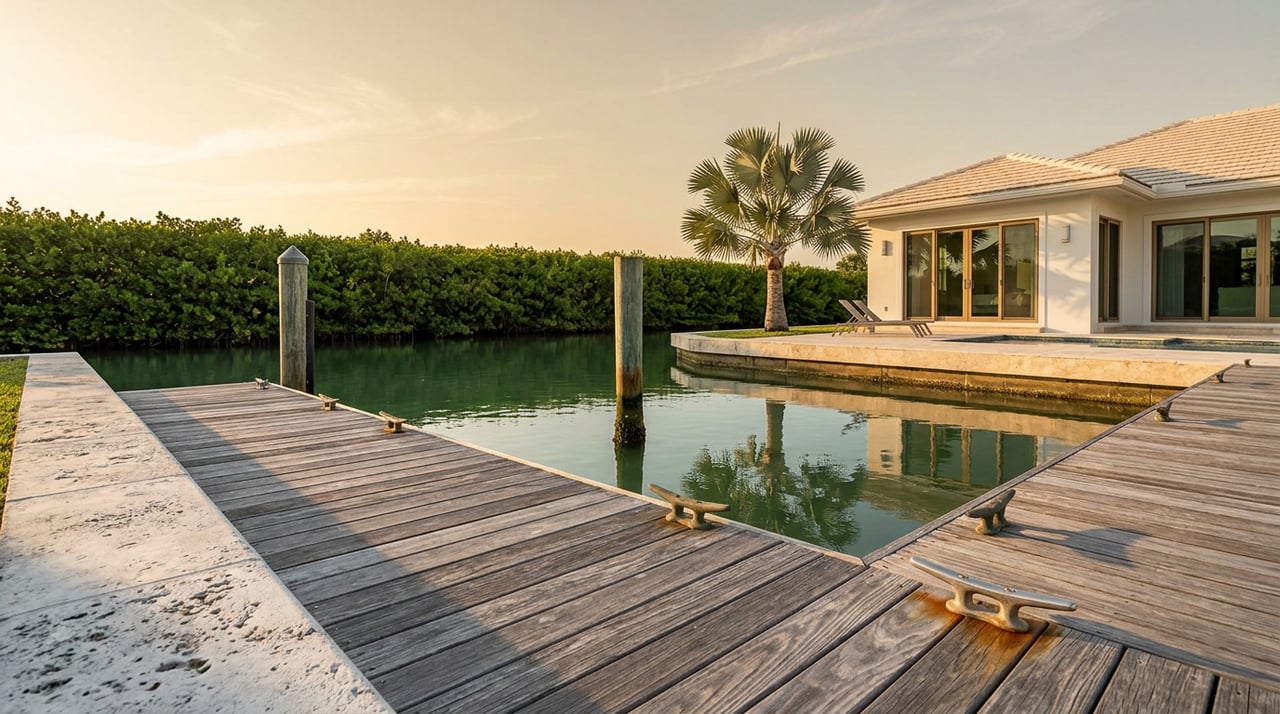
A buyer touring both neighborhoods in the same afternoon will eventually ask the obvious question. If a boat can leave either dock and reach the Gulf of Mexico without ducking under a bridge, why does one address routinely cost several times what the other does? The water is the same water. The pass is the same pass. Something else is doing the pricing.
The comparison is not explained by square footage or hull clearance alone. Port Royal Club eligibility is tied to certain parcels, while Aqualane Shores has no equivalent club.
The Water Doesn't Explain the Gap
Aqualane Shores and Port Royal are the two Naples neighborhoods where a boat owner can leave a private dock, enter Naples Bay, and reach Gordon Pass without waiting on a fixed bridge to open. That single feature sets both apart from most of the city's other waterfront communities. Homes along Doctors Pass, the route used by boaters in The Moorings and Park Shore, contend with a shallower, more tide-sensitive inlet. Royal Harbor's canals run narrower, a real consideration for anyone with a wide-beam catamaran or a larger motor yacht. Aqualane Shores and Port Royal do not share those limitations.
Port Royal does hold an edge in raw capacity. Its canals are wider and consistently deeper, which is why it functions as the regional benchmark for large motor yachts and deep-keeled sailboats even during a spring low tide. Aqualane Shores offers strong depth of its own, but the difference between the two at the high end of vessel size is real.
It is also not the difference that explains a multi-million dollar gap in asking prices. Within Aqualane Shores itself, value swings block to block based on canal width, turning basin size, dock configuration, and which bridge clearance route a boat has to take to leave the neighborhood, not on some blanket "Aqualane versus Port Royal" water quality gap. Two homes a few doors apart, both with no-bridge Gulf access, can carry very different price tags for reasons that have nothing to do with the Gulf.
Port Royal Club Membership and Parcel Eligibility
Port Royal Club eligibility is one part of the comparison, and it depends on the parcel.
Membership is not simply available to any Port Royal owner who chooses to buy it, as one might join a golf club across town. It is tied to the parcel itself, and only to certain parcels. Eligibility is generally limited to properties south of 21st Avenue South, and the right to join transfers with the land rather than sitting open to anyone who happens to own a house somewhere in the neighborhood. New owners of an eligible property have to decide within 90 days of closing whether to join outright, pay a reduced amount to preserve eligibility for later, or walk away from the club rights entirely.
The numbers attached to that decision are not small. As of this writing, the joining fee sits at $400,000, up from $315,000 following a scheduled increase that took effect January 1, 2026. Annual dues run around $16,200. Membership itself is capped at roughly 700, a ceiling set by the finite number of eligible parcels rather than by demand.
The club dates to 1959, and its clubhouse spent the past several years being rebuilt from the ground up after Hurricane Ian, at a construction cost reported near $100 million. The most current timeline points to a fall 2026 reopening, a slight push from earlier reports that had targeted summer. For a Port Royal buyer, that clubhouse is not an amenity somewhere down the street. It is Gulf-front dining, a private beach, tennis, and a pool, available to members through a parcel-specific eligibility structure.
That parcel-specific distinction is one factor in comparing the two neighborhoods.
What Aqualane Shores Sells Instead
Aqualane Shores has no equivalent structure. There is no master homeowners association, no mandatory club, no 90-day clock ticking after closing. Its geographic advantage is something Port Royal, by its own geography, cannot match as easily: a short walk to Third Street South and the beach.
Port Royal sits at the southern tip of the peninsula, generously scaled and quiet by design. Aqualane Shores sits between Port Royal and Old Naples, close enough to downtown that an owner can leave a dock, cross the bay, and just as easily leave the house on foot for dinner or a boutique on Third Street. Listings for new construction in the neighborhood have priced well into eight figures, with recent builds asking $25 million and higher, but the pitch attached to those prices leans on walkability and boating utility together, not on club access.
The comparison is not "better water" versus "worse water." It includes parcel-specific Port Royal Club eligibility and associated costs, as well as Aqualane Shores' proximity to Third Street South.
Quick Comparison
| Aqualane Shores | Port Royal | |
|---|---|---|
| Bridge-free Gulf access | Yes | Yes |
| Club membership | None required | Eligibility tied to certain parcels; new owners decide within 90 days of closing |
| Approximate single-family homes | 350 to 370 | 500 to 600 |
| Neighborhood established | Platted starting 1949, first homes 1950 | Dredged from marshland beginning in the late 1940s, first lots offered 1952 |
| Walk to Third Street South | Yes, several blocks | No |
| HOA structure | Non-gated, no master HOA | Club eligibility tied to certain parcels; no master HOA identified |
Both Neighborhoods Are Selling Land, Not Houses
There is a second thread worth pulling on for anyone comparing the two, and it has less to do with clubs and more to do with what is actually standing on the lot.
Aqualane Shores was carved out of mangrove starting in 1949, with its first completed homes dated to 1950. The overwhelming majority of those original structures are gone. What stands today is new construction or substantially rebuilt estates on the same footprints, with proper deep-water docks and boat lifts replacing whatever was there seventy years ago. Port Royal followed a similar arc. The neighborhood began as marshland purchased and dredged by a Chicago advertising executive named John Glenn Sample, with lots first offered to buyers in 1952 at prices that read almost like a typo today.
That history matters for a present-day buyer in a specific way. In both neighborhoods, a purchase is functionally a land and infrastructure decision. The house on top of the lot may be decades old, brand new, or somewhere in between, but the price is being set by the canal, the dock, the bridge clearance route, and in Port Royal's case, the club eligibility attached to the parcel. A buyer who falls in love with an existing structure without confirming what it is actually worth to rebuild around is pricing the wrong asset.
Working Through the Comparison
For a buyer trying to decide between the two, the framing is not "which neighborhood is better" but "which features do you actually want to pay for." A Port Royal purchase means checking club eligibility before an offer goes in, since eligibility varies by parcel, and building the joining fee and dues into the cost of ownership if choosing membership. An Aqualane Shores purchase means no equivalent club structure and a shorter walk to dinner.
Getting the eligibility question wrong in Port Royal, or misjudging a canal's turning radius in Aqualane Shores, is the kind of detail that surfaces during a transaction rather than during a showing. That is precisely where a second set of experienced eyes earns its keep.
Frequently Asked Questions
Does every home in Port Royal carry Port Royal Club eligibility? No. Eligibility is generally tied to properties south of 21st Avenue South, and not every parcel in the neighborhood carries the right to join. Confirming eligibility before making an offer is essential because eligibility varies by parcel.
Is Aqualane Shores gated? No. It is a non-gated neighborhood with no master homeowners association. Its privacy comes from estate-scale lots and limited through traffic rather than a controlled entrance.
Which neighborhood has the deeper canals? Port Royal's canals are generally wider and deeper, making it the regional standard for large motor yachts and deep-keeled sailboats. Aqualane Shores offers strong depth as well, though the two communities are not identical on this measure.
Comparing waterfront neighborhoods on price alone will always miss what actually drives the number. If you are weighing Port Royal against Aqualane Shores, or trying to work out what a specific canal, dock, or club eligibility is really worth before you write an offer, Pat Wilkins has spent decades reading these details for buyers and sellers across Naples and Marco Island. Schedule a consultation to talk through what your money actually buys in either address.
This article is general information, not legal, tax or financial advice. Consult a qualified professional about your situation.